- Female VC Lab
- Posts
- FinTech's Global Playbook: How Stablecoins, AI, and Open Rails Are Rewriting the Rules of Money
FinTech's Global Playbook: How Stablecoins, AI, and Open Rails Are Rewriting the Rules of Money

Barbara Bickham
May 12, 2026
Hi Impactful Listener!
There is a map sitting at the center of global finance right now — and it is being redrawn in real time.
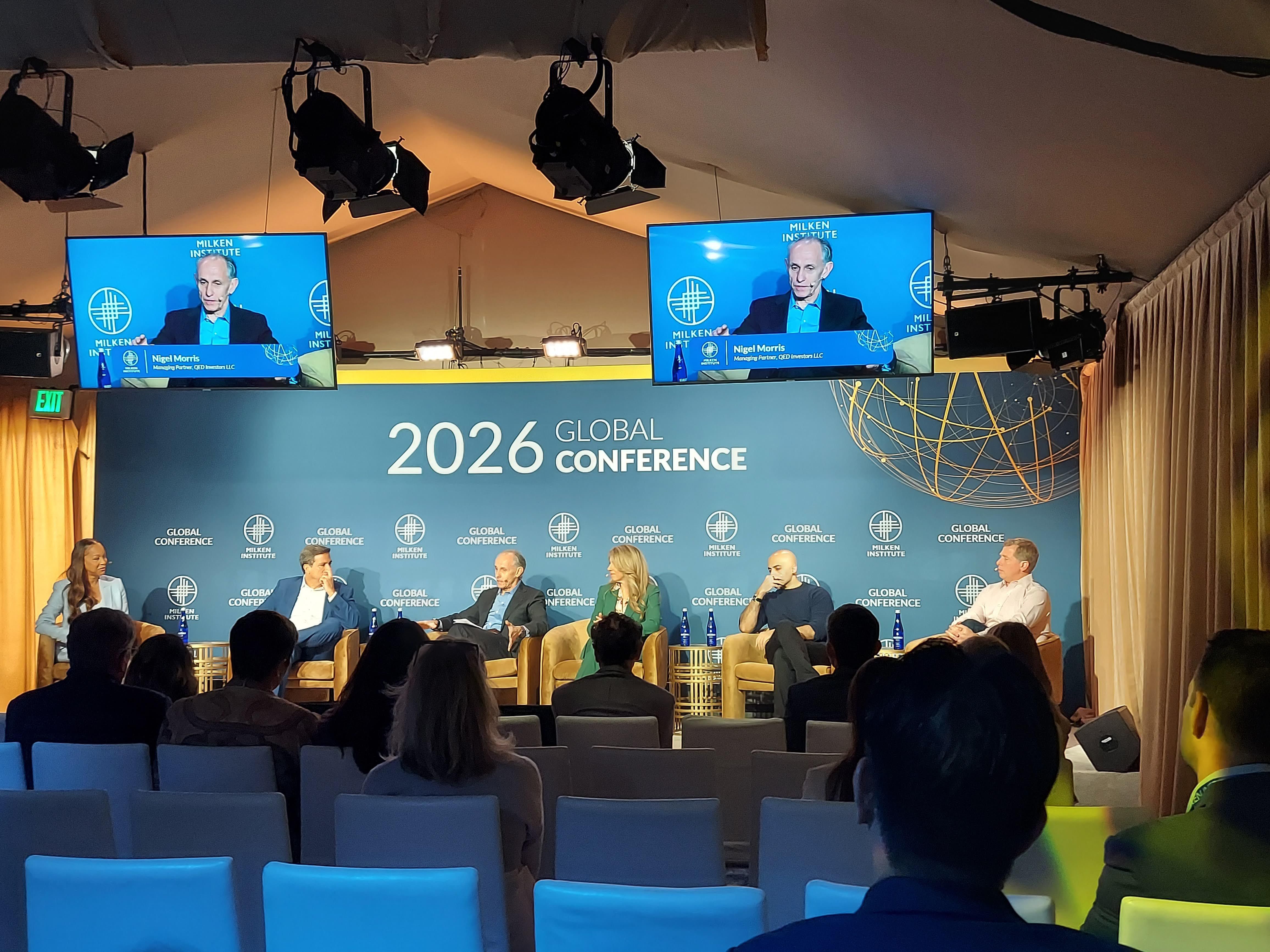
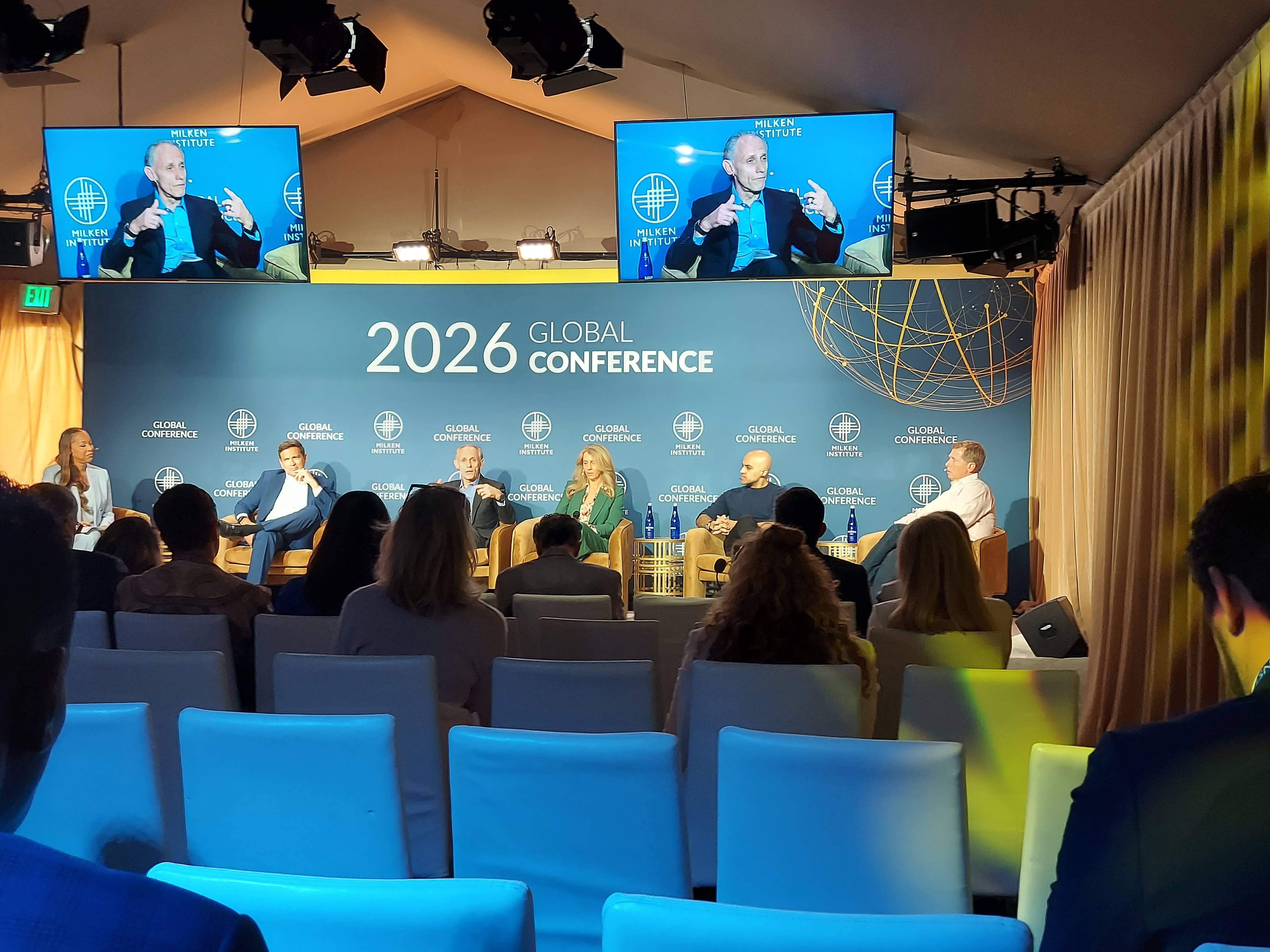
At the Milken Institute Global Conference 2026, five of the most influential voices in fintech gathered to explain exactly how. Moderated by Nicole Valentine, Senior Director of Fintech at the Milken Institute, the panel brought together Roberto Campos Neto, Vice Chairman and Global Head of Public Policy at Nubank and former President of the Central Bank of Brazil; Denelle Dixon, CEO and Executive Director of the Stellar Development Foundation; Nigel Morris, Managing Partner of QED Investors and co-founder of Capital One; Haseeb Qureshi, Managing Partner of Dragonfly, the crypto venture fund that recently closed a $650 million fund; and Barry Silbert, Founder and CEO of Digital Currency Group and founder of Grayscale.
The conversation ranged from São Paulo to Accra, from the GENIUS Act to agentic AI commerce, from $340 billion in stablecoin supply to the existential threat facing 4,250 of America's 4,300 community banks. What emerged was not a prediction, but a verdict: the architecture of global finance is being rebuilt, and the window for incumbents to respond is narrowing fast.
From Fifty-Five Percent to Eighty-Eight: The Brazil Blueprint
Roberto Campos Neto opened with a data point that framed everything that followed. When he joined the Central Bank of Brazil, bank account penetration — what economists call "bankarization" — stood at fifty-five percent. Today, Brazil sits at eighty-eight percent. That thirty-three percentage point shift did not happen through branch expansion. It happened through Pix, Brazil's instant payment system, and through the explosion of digital finance that it enabled.
The lesson, Campos Neto argued, is replicable. Mexico currently sits at fifty-five percent bankarization — the same starting line Brazil stood at a decade ago. The infrastructure exists. The playbook has been written. The question is whether the political and regulatory will can be assembled in time.
Nubank is the most visible proof of concept. Having surpassed 127 million customers globally as of late 2025 — with 110 million in Brazil alone, representing roughly 61% of the country's adult population — the company has become the largest digital bank on the planet. Its net promoter scores consistently register in the nineties, a figure that Nigel Morris, who has spent four decades in financial services, called "Herculean." "You don't just get there by trying," Morris said. "You have to have perfect product market fit, wonderful execution. You have to be really solving the problems that the consumers have."
That problem-solving orientation, Campos Neto noted, is now being coded into the infrastructure itself. Brazil's open finance system allows any Nubank customer to migrate all their data — and all their financial products — across institutions with two clicks. Real-time comparability and portability, at scale. "The value of data is completely underestimated today," he said.
Stablecoins: Not Just a Technology — A Cultural Revolution
If Brazil's bankarization story represents what fintech has already accomplished, stablecoins represent what comes next. And according to Haseeb Qureshi, the frame most analysts use to understand them is fundamentally wrong.
"Stablecoins are not just a technological innovation," Qureshi said. "They might be even more so a cultural innovation." The distinction matters. What stablecoins have achieved — and what the GENIUS Act, signed into law in July 2025, has now formalized — is a world in which any person, anywhere, with a mobile phone, can hold US dollars and send them instantaneously to anyone else on the planet. No bank account required. No correspondent banking fees. No waiting three to five business days.
The GENIUS Act, the first federal stablecoin legislation in the United States' history, established a regulatory framework that requires 100% reserve backing with liquid assets and mandates monthly public disclosures. Critically, permitted payment stablecoins are not classified as securities. What it created, in Qureshi's framing, is a permission-less financial primitive: "You create a wallet, a cryptographic key, and now you have money. That's it. Beginning and end."
The scale is staggering. The stablecoin market surpassed $320 billion in April 2026 and continues to accelerate, with projections toward $1 trillion by end of year. More telling than the aggregate number is its composition: 99.8% of all stablecoins in existence are denominated in US dollars. The United States is not just participating in the stablecoin market — it is the stablecoin market.
Former Treasury Secretary Scott Bessent has projected stablecoins could reach $2.7 trillion by the end of the decade — roughly 15% of M2 money supply. "At that point," Qureshi said, "this is not an experiment. This is the future of the way that dollars are going to be traveling around the world."
But Qureshi's framing goes further than economics. He situates stablecoins within a broader geopolitical shift — a move toward a more multipolar, decentralized world order. The moment Russia's dollar reserves were frozen during the Ukraine war, he argued, was the "shot across the bow" that made every central bank viscerally aware that the US dollar was a political tool. Stablecoins offer a different architecture: dollar exposure without dollar dependence on the goodwill of any sovereign actor. "Stablecoins transfer power from governments to individuals," he said plainly.
Africa, Asia, and the Last-Mile Revolution
The permission-less quality of blockchain rails is not an abstraction in emerging markets — it is the difference between access and exclusion.
Denelle Dixon, whose work at the Stellar Development Foundation spans the African continent extensively, illustrated the problem with precision. A content creator in Africa who wants to receive payment from YouTube, TikTok, or Facebook needs a US dollar bank account. Getting a US dollar bank account requires establishing a US address. That means physically traveling to the United States — a requirement that is economically and logistically impossible for most creators on the continent.
"That's just not workable," Dixon said. The solution Stellar has helped build: US dollar virtual accounts that allow creators to receive payments in USD, convert to local currency through local rails that handle KYC and AML compliance, without ever leaving the continent. "It is remarkable and game changing," she said. "It equalizes the playing field."
The same infrastructure is transforming SME financing. Businesses that previously had no access to capital markets can now raise crowdsourced funding on-chain. Cross-border payments that once took days and cost double-digit percentages of transaction value now settle in seconds for a fraction of a cent. Dixon cited Stellar's benchmark: less than 1/100th of a penny to send value on the network, settling in under one second.
Nigel Morris underscored this with QED's portfolio. The firm led the Series A in Remitly a decade ago, betting on digital-first international money transfer. Remitly and Wise together dismantled the physical money transfer corridor business that Western Union and MoneyGram had dominated for generations. Now a second generation has emerged: Felix Pago, a QED portfolio company focused on the US-Mexico corridor, uses WhatsApp as its onboarding and transaction interface — meeting migrants exactly where they already communicate.
"The pipes are increasingly becoming stablecoins," Morris said. "Real time, 24/7, immutable audit trails, virtually no cost."
Institutional Legitimacy: The Franklin Templeton Moment
The signal that institutional finance had arrived came not from a bank, but from a 75-year-old asset manager. Franklin Templeton built its Benji money market fund on the Stellar network — without ever notifying the Foundation first. "They picked the tech stack on their own," Dixon recounted. "They didn't talk to us beforehand. That is what open technology allows. That is permissionless."
The fund launched five years ago. By April 2026, the Benji suite had crossed $1.98 billion in assets under management, with nearly $480 million on the Stellar blockchain. The SEC's decision to allow peer-to-peer transfers of fund shares has opened a new dimension: investors can now hold the fund for minutes, earn pro-rata interest, and transfer shares to any counterparty without clearing through traditional custodians.
"You can go in, you hold the asset for three minutes, you go out of it, you get your interest for those three minutes," Dixon explained. "This is the value of what the technology allows."
For Barry Silbert, this is merely the opening act of a much larger transformation. "The next big thing is going to be tokenization," he said. "At some point in the future, my belief is every investable asset — the ownership of that asset is going to be recorded on the blockchain." The implication is a collapse of the public/private and US/non-US market distinctions that have governed capital formation for decades. "We're going to go from this idea of public versus private, US markets versus non-US markets, to a global level playing field for capital formation."
The Dollarization Dilemma
Not everyone in the room was purely celebratory. Campos Neto, who spent six years as Brazil's central banker, introduced a crucial counterweight that frames the challenge for family offices and sovereign investors watching these dynamics.
Stablecoin adoption is growing 200–300% annually in emerging markets, he noted — and the primary driver is not transactional utility. When his team analyzed Brazilian stablecoin usage, they found the turnover rate of stablecoins was one-fourth that of quasi-money. People were not buying stablecoins to transact. They were buying them as a cheap way to hold US dollar accounts. The less convertible a local currency, and the more volatile an economy, the faster stablecoin adoption grows.
This creates a structural risk for smaller economies. "If you look at some of the smaller countries," Campos Neto said, "it is growing to an extent that is going to start hurting the credit function of the economy." When domestic savings dollarize at speed, local banks lose the deposit base that enables them to extend credit. Monetary policy — the primary lever central banks have to stabilize economies — becomes progressively less effective.
Silbert framed this as the dark side of a system that is otherwise deeply liberating: giving the US Treasury the ability to effectively expand the dollar supply globally, while eliminating the monetary policy sovereignty of smaller nations. "I don't think a lot of people are thinking about the negative effects of a US dollarized world," he said.
Dixon's response: the answer lies in the design of the last mile. Ghana, for example, has developed the ability to receive US dollar stablecoins and convert them directly to mobile money — preserving local economic participation without sacrificing access to dollar stability. Tokenized government debt — "stable bonds" that export sovereign debt to international holders on-chain — represents another tool: investors can hold exposure to a local currency government bond without the friction of FX conversion, maintaining demand for local currency instruments even in a stablecoin-dominant world.
Agentic Commerce and the Value Economy
The newest frontier surfaced in the panel's final act: the collision between agentic AI and financial services. Nicole Valentine framed the question simply — can you give your finances to an AI agent that makes purchases for you? Who is liable when the agent transacts?
Campos Neto offered a framework that recontextualizes the entire conversation. If token usage — computational access — is becoming the new monetary unit (as evidenced by engineers negotiating token allocations alongside salary and bonus), then the binding constraints of the future economy are energy and compute, not capital or credit. In a fully tokenized economy, every asset traffics on-chain in programmable form, and the monetary unit itself is tied to productive infrastructure.
Dixon connected the AI thread back to Stellar's own roadmap. Standards like MCP and X402, already integrated into Stellar, are building the payment rails for agentic commerce — enabling AI agents to transact on behalf of users across the open web. "We're going to have an agent that comes back to you with a web view," she said. "You're not probably going to eventually go to the web yourself." The attention economy — built on eyeballs — gives way to the value economy, where agents transact autonomously and micropayments flow at the infrastructure layer.
Silbert pointed to Bittensor, a decentralized network in DCG's portfolio, as the infrastructure layer for this future: a blockchain-based system that uses the TAO token to incentivize contributions of compute, data, and storage — effectively a decentralized marketplace for AI intelligence. "The future of AI," he said, "is going to hopefully be built and innovated not in the walls of an OpenAI or Anthropic, but in a decentralized way."
The Fifth Age — And the 4,250 Banks That Won't Survive It
Nigel Morris has a specific number on the competitive threat facing US banking. QED's latest report with McKinsey, which defines the current moment as the "Fifth Age of Fintech," provides the arithmetic: global fintech revenues reached approximately $650 billion in 2025, growing at 21% year-over-year, against incumbent revenue growth of 6%. Fintechs currently hold roughly 4% market share of the $15.5 trillion global financial services revenue base. By 2030, at the current differential in growth rates, that share reaches 10%.
Meanwhile, 21 fintechs applied for US banking charters in 2025 alone — more than in the previous four years combined. Global challengers like Nubank, Revolut, Klarna, and Monzo have now built profitable, high-growth businesses with net promoter scores that dwarf incumbents. They are arriving in the US with proven playbooks, banking licenses, and AI-powered operations. "Arm them with agentic AI, and they're based in Delaware," Morris said. "They can issue credit cards with their export rates, and they can come after the deposit franchises of 4,300 banks."
His conclusion was unsparing: "4,250 of them are subscale and don't have the capability to protect themselves from an onslaught that's coming. Banks constantly confuse inertia with loyalty, and when that inertia goes down, we're going to see real opportunity."
Leadership for the New Era
The panel closed with a question that had no safe answer: what kind of leader does this moment require?
The consensus was striking in its consistency. Adaptability, not expertise, is the primary trait. Curiosity — not about technology in the abstract, but about the specific problems of specific markets — is the differentiator. Technical literacy is table stakes; the days of CEOs who "sub out" technology questions to the CTO are ending.
Dixon shared the practice she has built at Stellar: every Thursday all-hands, a different team member presents what they have done with AI in the past two weeks. Not which AI marketing tool they used — but how AI changed the way they worked. "I think that is something that is really, really important," she said, "and it drives change."
Morris reached back to Darwin: "It's not the strongest or the biggest that survive. It's the ones that are the most adaptable." In an industry where a 75-year-old asset manager can build on a blockchain without asking permission, where a fintech can deploy a full bank in a new country with 50 employees at a 20% efficiency ratio, the old hierarchical structures — "Greek and Roman military structures," as Morris put it — cannot respond at the speed the market now demands.
Qureshi's screening question for every founder interview captures the moment precisely: "How do you use AI in your day? And the weirder it is, the more I'm like: okay, you're somebody I potentially want to work with."
The Verdict
What emerged from the Milken stage on May 5, 2026, was not a set of predictions. It was a status report on a transformation already underway. The rails have been built. The regulatory framework — at least in the United States — has been established. The institutional capital has arrived. The question is no longer whether fintech, stablecoins, and blockchain-based finance will reshape the global financial system. It is how quickly the people running that system will recognize that the map has already changed.
For investors, family offices, and enterprise decision-makers, the strategic implication is clear: the fintech penetration rate is 4%. The trajectory points to 10% by 2030. The next trillion-dollar financial institution may already be filing for a banking license. The corridors it will serve — São Paulo to New York, Lagos to London, Manila to Manila — will run on rails that are cheaper, faster, and more transparent than anything the legacy system has ever built.
The new map is being drawn. The only question is where you are on it.
Sources:
This article is based on the "FinTech's Global Playbook: Breaking Barriers and Borders" panel at the 2026 Milken Institute Global Conference, featuring Roberto Campos Neto (Nubank), Denelle Dixon (Stellar Development Foundation), Nigel Morris (QED Investors), Haseeb Qureshi (Dragonfly), and Barry Silbert (DCG/Grayscale), moderated by Nicole Valentine (Milken Institute)
Subscribe to The Female VC Lab newsletter for updates, exclusive content, and to stay connected with the world of female investors.
Reply